Overview
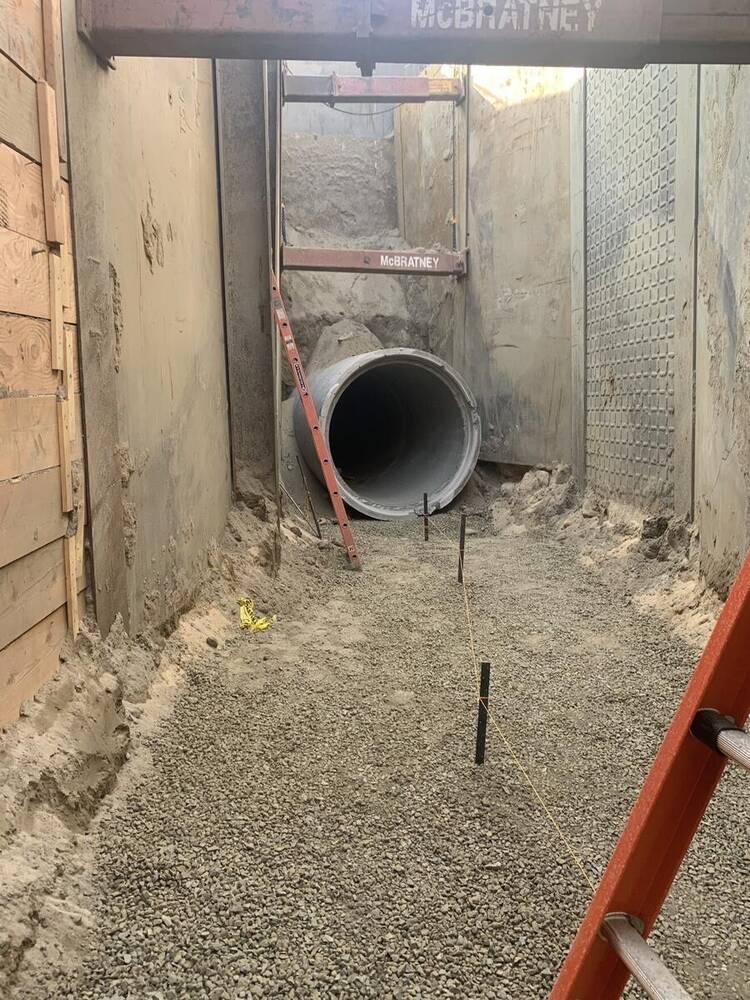
Storm drain work covers the widest range of scale in underground utility construction — from a single catch basin on a commercial pad to the large-diameter trunk lines that carry runoff for an entire industrial development. We've built both. Large-diameter RCP storm drain installation for major logistics and industrial sites means moving significant pipe through significant depth, with trench shoring and bedding work that scales accordingly; smaller commercial and residential storm systems mean tighter coordination with paving, landscaping, and other site trades working the same footprint at the same time.
What doesn't change with scale is the consequence of getting it wrong. A storm system undersized or misgraded doesn't fail on a dry day — it fails in the first real storm, when the property it's supposed to protect is already flooding. Storm drain is the utility scope where the design engineer's calculations and the contractor's fieldwork have to match exactly, because there's no adjusting pipe capacity after it's buried under a parking lot.
What We Install
Large-diameter RCP (reinforced concrete pipe) storm drain mainline installation
HDPE storm pipe installation for smaller-diameter runs and tighter-radius alignments
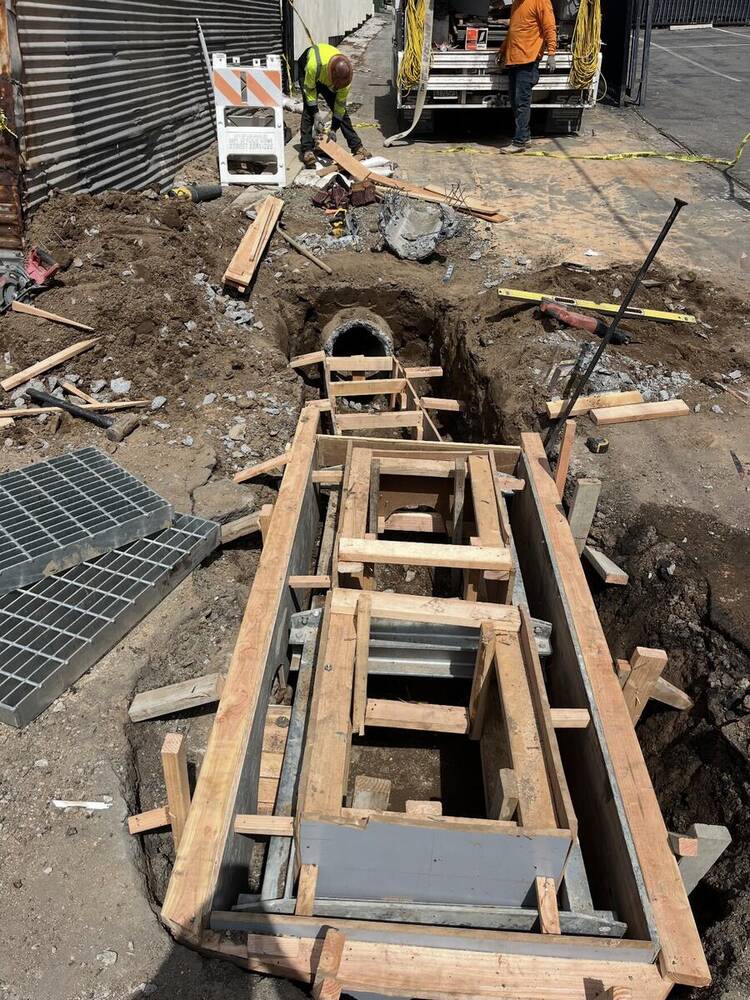
Catch basins, area drains, and grated inlets sized and placed per the approved drainage plan
Junction structures and manholes for storm systems, including energy dissipation where required
Detention and retention system tie-ins, including outlet control structures
Drainage improvements and regrading for developments of all sizes, public and private
Our Process
01
Drainage Plan Review
We review the civil engineer's drainage plan against actual site grading and existing storm infrastructure before committing to a bid, since storm systems are the utility scope most sensitive to as-designed vs. as-built grade discrepancies.
02
Excavation & Shoring
Large-diameter storm mainline often means the deepest trenches on a site — shoring is sized to depth and soil conditions, and crews are staged around safe entry and exit at that depth.
03
Bedding & Pipe Placement
RCP joints are set to manufacturer gasket specs and line-and-grade is laser-controlled; a storm line that doesn't hold design slope loses the capacity the drainage calculation assumed it would have.
04
Structure Installation
Catch basins, junction structures, and manholes are set at the elevations the drainage plan calls for, with inverts matched to connecting pipe runs.
05
Backfill & Compaction
Controlled backfill lifts and compaction testing, particularly critical under paving sections that will carry vehicle loading.
06
Inspection & Video Verification
Mainline video inspection confirms the installed system matches design grade and is clear of debris and joint offsets before the site is turned over.
Materials & Methods
RCP remains the standard for larger-diameter storm mainline where structural loading and longevity matter most, specified by pipe class to match the burial depth and surface loading on the drawings. HDPE has become common for smaller-diameter runs and alignments needing tighter bend radii, offering faster joint assembly and corrosion resistance. Catch basins and junction structures are typically precast concrete, with structure size and outlet configuration matched to the hydraulic calculations in the drainage report rather than a one-size-fits-all standard detail.
Scale Changes the Job
A storm drain scope for a single commercial pad and a storm drain scope for an industrial logistics park are built with the same fundamentals but very different logistics. Large-diameter trunk line work means dedicated equipment, larger crews, and shoring plans engineered specifically for that depth and soil condition — it's closer to heavy civil work than typical utility construction. Smaller commercial systems trade that scale for tighter site coordination, since a catch basin and its connecting run usually has to thread between building footings, parking structure, and landscaping already staked out on site. We bid both the same way: by looking at the actual drawings and site conditions, not by applying a flat rate per linear foot regardless of what's really involved.
FAQ
Storm Drain FAQ
What types of storm drain systems does Legend Pipeline install?
Legend Pipeline installs underground storm drainage infrastructure for commercial developments, industrial sites, and other construction projects based on engineered plans and specifications.
What components can be included in a storm drain system?
Depending on the project, storm drain scopes may include underground piping, catch basins, manholes, drainage structures, connections, and other associated infrastructure.
Does Legend Pipeline install large-diameter storm drain pipe?
Pipe sizes and materials vary significantly by project. Send us your civil plans and specifications so our team can evaluate the requirements of your storm drain scope.
Why is proper grading and elevation important for storm drain installation?
Storm drainage systems rely on specified elevations and slopes to move water through the system effectively. Installation must follow the project's engineered plans and requirements.
Can you perform storm drain work as part of a larger wet utility package?
Yes. Storm drain installation can be coordinated alongside sewer, water, and fireline scopes when multiple underground utilities are included in a project.
Bidding a Similar Scope?
Bidding a storm drain scope, large or small? Send the drainage plan and any geotechnical report available, and we'll bid to the actual depth, pipe class, and structure count on the drawings.
Contact
Let's talk about your next project
Bidding opportunities, plan review, partnerships, or general questions — reach out and we'll respond promptly.
Phone(951) 870-8838
LicenseCA Contractors License CL #1080408
Service AreaLA · OC · RIV · SB · SD
Follow